Category: Flutter

  • [AoNW] One Game, Two Views: Extracting the Rust Engine and Building AoNW2 in Godot

    The existing Flutter and Flame client received many new gameplay systems, multiplayer improvements, performance fixes, and better release tooling.

    But the biggest recent change is architectural.

    I started separating the game itself from the technology used to display it.

    The long-term structure will have:

    • AoNW1, the existing 2D client built with Flutter and Flame
    • AoNW2, a new 3D client built with Godot
    • one shared game engine written in Rust
    • one Serverpod multiplayer backend
    • one set of rules, maps, commands, events, saves, and multiplayer contracts

    This is not a plan to abandon AoNW1.

    It is a plan to make the game independent from both Flutter and Godot.

    The most important product decision is also simple:

    AoNW1 and AoNW2 will use the same multiplayer system. Players using the 2D and 3D clients will be able to join the same matches.

    From the gameplay point of view, both clients should be the same game.

    The difference should be presentation:

    • AoNW1 shows the world as a 2D hex map
    • AoNW2 shows the same world as a 3D scene

    They will not have separate combat rules, separate balance, separate AI, or separate multiplayer servers.

    (more…)
  • [AoNW] An Interactive Map of the Game Architecture

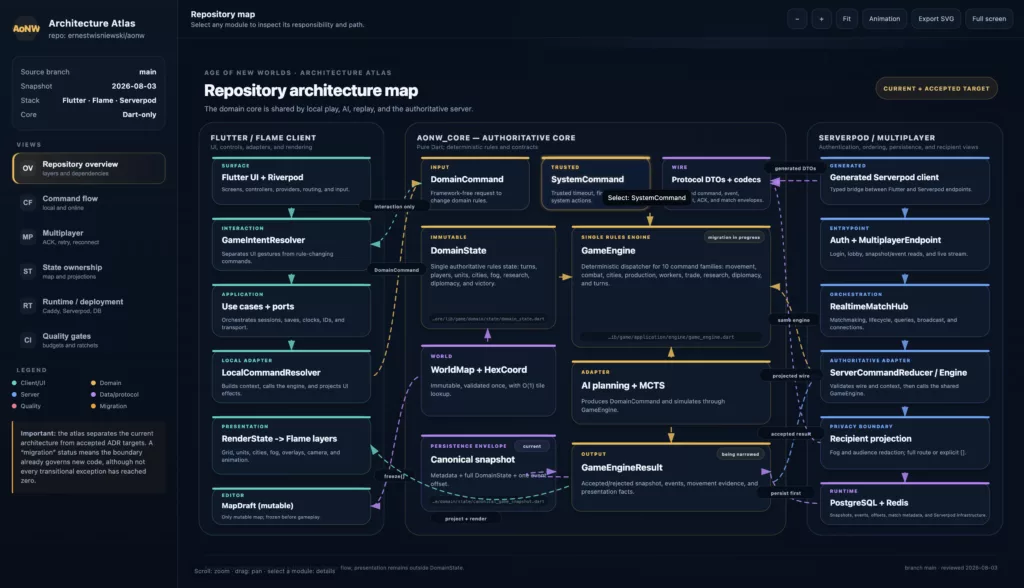
    Most of the recent work on Age of New Worlds has happened below the visible game.

    The shared engine, multiplayer flows, state boundaries, runtime services, deployment, and quality gates have gradually become one connected system. Describing these changes across separate refactor posts was useful, but it was still difficult to see the whole repository at once.

    I have now published an interactive AoNW Architecture Atlas. It lets you explore the repository by module, follow the main application flows, and distinguish the current implementation from accepted migration targets.

    Explore it here: aonw.net/architecture

    This is not an architecture frozen in time.

    It is a snapshot of where the project is now, and a map for where the next changes belong.

  • [AoNW] The Refactor So Far: Breaking Up the Runtime Around the Game Engine

    Since the previous refactor update, Age of New Worlds has kept one canonical GameEngine, but the runtime around it has changed substantially. The main game-state provider, Flame renderer, network session layer, and Serverpod multiplayer services have been split into explicit responsibilities. At the same time, presentation parity tests and aggregate architecture budgets now make it harder for the same complexity to grow back under different filenames.

    Finishing the shared game engine did not finish the refactor.

    (more…)
  • [AoNW] The Refactor So Far: Finishing the Shared Game Engine Refactor

    Since the previous refactor update, Age of New Worlds has moved local play, multiplayer, AI simulations, replay, presentation effects, and match lifecycle behind one canonical game engine. The visible result is fewer synchronization bugs. The architectural result is one authoritative path from command to state, events, and animation.

    Since the previous refactor update, most of the work has not been about adding another visible system.

    It has been about removing alternative ways in which the same game could be interpreted.

    (more…)
  • [AoNW] The Refactor So Far: Movement Now Survives the Network

    In the previous update, AoNW already had one canonical turn pipeline and a growing set of shared game rules. Local play, the multiplayer server, AI simulations, and turn processing were starting to use the same implementations instead of maintaining similar versions of the same behaviour.

    Movement was one of the largest parts of that work. Manual movement, auto-exploration, queued paths, fog updates, and AI movement had moved toward one shared model. The engine could calculate the exact route taken by a unit, including every step and its movement cost.

    (more…)
  • [AoNW] The Refactor So Far: The Map Adapter Is Gone and DomainState Is Real

    In the original refactor post, I described the target architecture and a plan for reaching it without rewriting the whole game. In the previous progress update, the project already had stronger quality gates and one indexed map model, but the migration was not complete because two production conversions still existed, the legacy map adapter was still alive, and DomainState was mostly a target shown on a diagram rather than a type used by real gameplay paths.

    That is no longer the current shape of the project. The last map adapter has been deleted, the local reducer uses read-only map contracts, several old state models now own their collections instead of borrowing mutable lists and maps, and a real DomainState exists together with a canonical snapshot that separates game rules, match session data, metadata, persisted interaction, and the event offset. Turn combat and turn movement now run directly on this canonical state, while only the economy phase still uses the old persistent model.

    (more…)
  • [AoNW] The Refactor So Far: One Map, Better Gates, Less Drift

    In the previous post, I described a plan to refactor Age of New Worlds without rewriting it.

    The plan looked clean on paper.

    Then the real work started.

    The goal was not to move files around or rename a few classes. The goal was to remove duplicate paths while keeping the game working after every step.

    The first safety work is now complete. Most of the new quality gates are running. The map migration is far advanced. Some real inconsistencies were found and fixed along the way.

    (more…)
  • [AoNW] Refactoring a Growing Flutter 4X Game Without Rewriting It

    When I wrote the first article about Age of New Worlds, the basic game loop was already working.

    I could explore a hex map, found cities, move units, manage production, research technologies, improve terrain, end turns, and save the game. Flutter and Flame had already proved they could handle a 4X game. The new question was whether I could keep adding features without making the code harder to change every time.

    (more…)
  • [AoNW] Shipping a Flutter Game to Multiple Platforms

    Age of New Worlds is now available outside my development machine. The current release covers iOS, macOS, Windows, Linux, and Android, with a web demo, direct downloads, store versions, and source code available publicly. That was the original technical goal: build one game codebase and make it run on real platforms.

    Where To Play

    (more…)
  • [AoNW] Adding Gamepad Support to a Flutter 4X Game

    Age of New Worlds started as a mobile-first game.

    That shaped a lot of early decisions. The map had to work with touch. The HUD had to survive small screens. Panels had to slide in and out without burying the world. Most interactions were built around taps, long presses, drags, and responsive layouts.

    For a while, that was enough.

    Then the game started growing toward more platforms: web, desktop, Steam, and eventually devices like the Steam Deck. At that point controller support stopped being a nice extra and became part of the shape of the game.

    (more…)